


You've fought alongside AI teammates that walked into walls. You've watched enemy NPCs repeat the same patrol route for the hundredth time. You've screamed at your screen because the "smart" boss just stood there while you slowly chipped away at its health bar.
Traditional game AI isn't intelligent. It's a puppet show: elaborate scripts and if-then statements dressed up to look like thinking. But something different is happening now, and it's going to change everything about how games feel to play.
World models in gaming represent a fundamental shift: AI systems that actually understand game worlds rather than just reacting to them. And if you've ever wished NPCs felt more alive or that your AI squadmates showed a hint of genuine strategy, this technology is what you've been waiting for.
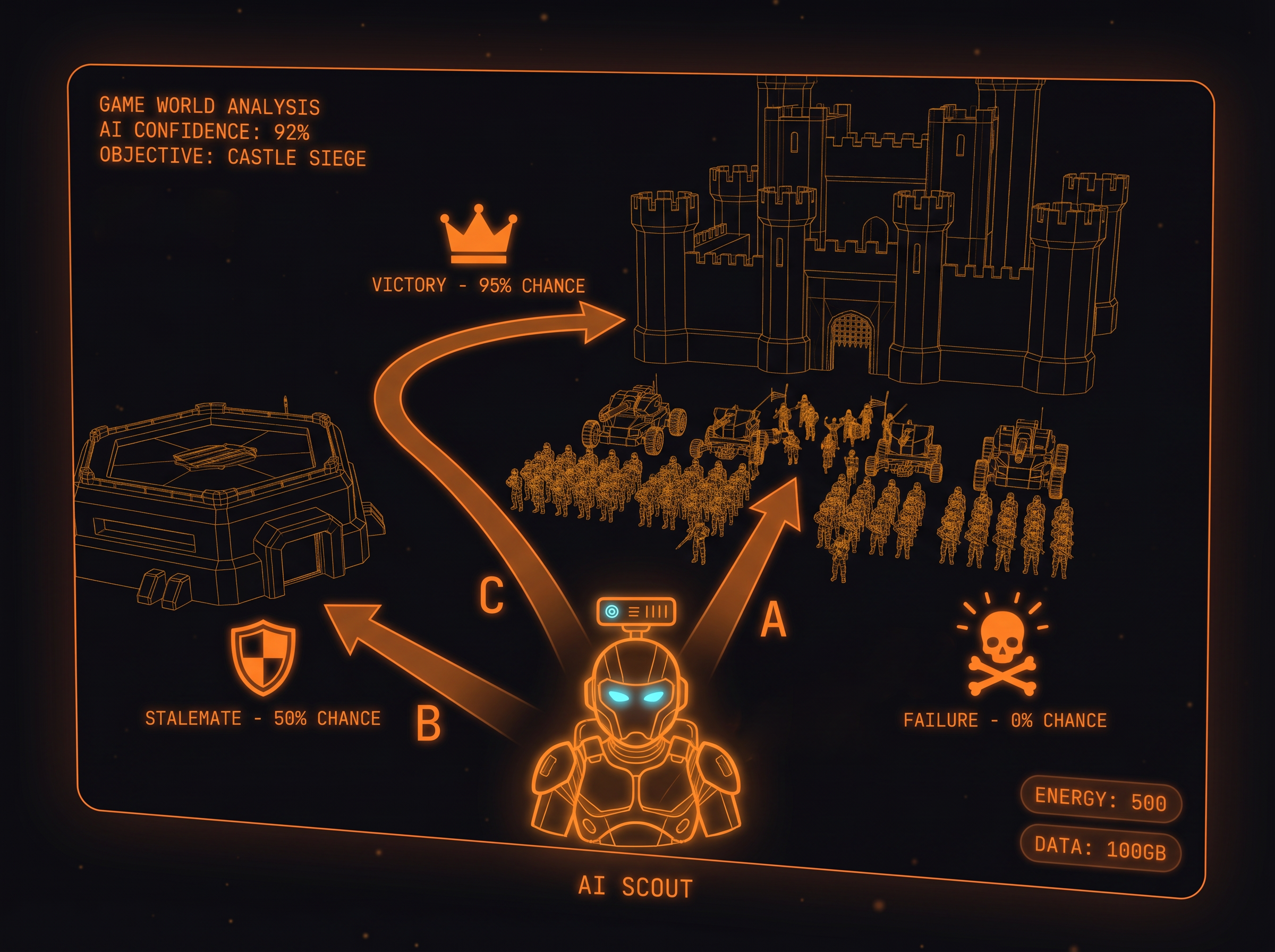
World models build internal simulations of game environments, predicting outcomes before actions happen.
What Are World Models? (And Why Should You Care?)
Here's the simplest way to think about it: a world model is an AI that plays the game in its head before making a move.
Traditional game AI works like a cookbook. Encounter a player? Check recipe for "player encounter." Recipe says: if player distance < 10 meters, attack. If health < 20%, flee. Simple. Predictable. Boring.
World models work differently. They build an internal simulation of the game world—physics, rules, cause and effect—and use that simulation to predict what happens next. It's the difference between following a script and genuinely understanding the scene.
Think about how you play games. When you're sneaking through an enemy base, you're not just reacting to what's on screen. You're running simulations in your head. "If I throw a rock over there, the guard will investigate. That gives me a three-second window to slip past." You understand the logic of the world, not just its current state.
World model AI does the same thing. It learns how game worlds work. How physics behave, how characters respond, what actions lead to what outcomes and uses that understanding to make decisions.
How World Models Differ from Traditional Game AI
Let's get specific about what makes world model AI different from the AI you've been playing against for decades.
Pattern Matching vs. Actual Understanding
Traditional game AI is basically very sophisticated pattern matching. Developers program behaviors: "When you see pattern A, do action B." Fighting game AI recognizes your combo startup and blocks. Stealth game AI follows predetermined patrol routes. Strategy game AI uses decision trees that players eventually memorize and exploit.
The AI isn't understanding anything. It's matching inputs to outputs.
World models flip this completely. Instead of "if X then Y" rules, the AI learns a model of how the entire game world functions. It can then use that model to reason about situations it's never encountered before. Never seen a player use that weapon combination? Doesn't matter—the AI understands how weapons work and can predict the outcome.
This is AI game understanding in the truest sense. The AI isn't memorizing; it's comprehending.
The Prediction Engine
Here's what's wild about world models: they can literally imagine the future.
The AI runs simulations forward in time. It asks itself: "If I do action A, what happens next? What about action B? Which outcome gets me closer to my goal?" This is called "imagination-based planning," and it's how humans make complex decisions.
When you're playing chess, you're simulating possible futures. "If I move my knight here, they'll probably take it with their bishop, then I can..." World model AI does this automatically, potentially running hundreds of simulated futures before choosing its next move.
Learning from Experience, Not Programming
Traditional game AI requires developers to anticipate every situation and program appropriate responses. That's why AI breaks in unexpected ways, developers can't think of everything.
World models learn from data. Show the AI thousands of hours of gameplay, and it extracts the underlying rules. Physics. Cause and effect. Player behaviors. Game logic. The AI figures out how the world works by observing it, not by having rules programmed in.
This is why world models gaming represents such a big leap. The AI becomes increasingly competent the more it plays, just like human players do.
Real Examples: World Models Already Exist
This isn't science fiction. Researchers have been building world models for games, and the results are genuinely impressive.
DeepMind's Genie
Google DeepMind released Genie in 2024, and it broke a lot of people's brains. Genie can generate playable 2D game worlds from a single image. Show it a screenshot—any screenshot—and it creates an interactive environment you can actually play in.
How? Genie learned a world model from watching hundreds of hours of 2D platformer footage. It didn't just learn to copy what it saw—it learned the underlying rules of platformer worlds. Physics. Character movement. How platforms work. The model internalized what makes a 2D game a 2D game.
Then, when you show it a new image, it applies that understanding to create a playable experience. That's not image generation—that's world understanding.
Dreamer and DreamerV3
Dreamer is a world model architecture that learns to play games by dreaming about them. Literally.
The AI builds a compressed model of the game environment in its "imagination," then practices playing in that imagined world. It dreams up scenarios, tests strategies, and learns from its imaginary experiences. When it's time to actually play, the AI already has intuitions about what works.
DreamerV3 became the first world model to achieve human-level performance on Minecraft without being given any game-specific instructions. It figured out how Minecraft works—the crafting system, the physics, the day/night cycle—by building an internal model and learning through imagination.
GameNGen
GameNGen took things in a wild direction: using world models to generate game frames in real-time. Researchers created a system that could generate playable DOOM frames at 20fps, with the AI predicting each frame based on player input.
Think about what that means. The AI had internalized DOOM's world model so completely that it could generate the game in real-time. Not running the actual DOOM engine—generating what DOOM would look like if you were playing it. The AI understood DOOM's world well enough to simulate it.
This is world model gaming taken to its logical extreme: AI that understands games so well it can recreate them from pure understanding.
Why Onchain Games Are Perfect for World Model AI
Here's where things get interesting for the gaming industry—and where onchain games have a massive advantage.
Traditional games are black boxes. The game logic lives on company servers or locked inside compiled code. AI researchers can watch gameplay footage, but they can't directly observe the underlying systems. They're learning from shadows on the wall.
Onchain games are radically transparent. Every game state change, every transaction, every piece of logic is verifiable and accessible. The game's rules aren't hidden—they're published on the blockchain for anyone to inspect.
Verifiable State
When an AI learns a world model from traditional game footage, it's essentially guessing at the rules. It observes patterns and infers logic. Sometimes it gets things wrong.
With onchain games, the AI can see the actual game state. Not just what's rendered on screen, but the true underlying variables. Health values. Inventory states. World coordinates. Everything is right there in the blockchain data.
This means cleaner training data and more accurate world models. The AI isn't inferring rules from pixels—it's learning from the ground truth.
Open APIs and Permissionless Access
Training world models requires data. Lots of data. Traditional game companies guard their data jealously. Want to train an AI on World of Warcraft? Good luck getting Blizzard to cooperate.
Onchain games are different by design. Anyone can read the blockchain. Anyone can build tools that interact with the game. Anyone can collect training data and build world models. The permissionless nature of blockchain games removes the gatekeepers that make AI research difficult in traditional gaming.
Cartridge and the Open Gaming Stack
This is exactly the future that platforms like Cartridge are building toward. By providing the infrastructure for onchain games—the controllers, the identity systems, the game deployment tools—Cartridge is creating an ecosystem where games and AI can coexist and enhance each other.
When games run on open infrastructure with transparent state, world model AI becomes dramatically easier to build. Players benefit from smarter NPCs and better AI companions. Developers benefit from AI tools that actually understand their games. And the entire ecosystem benefits from the innovation that permissionless access enables.
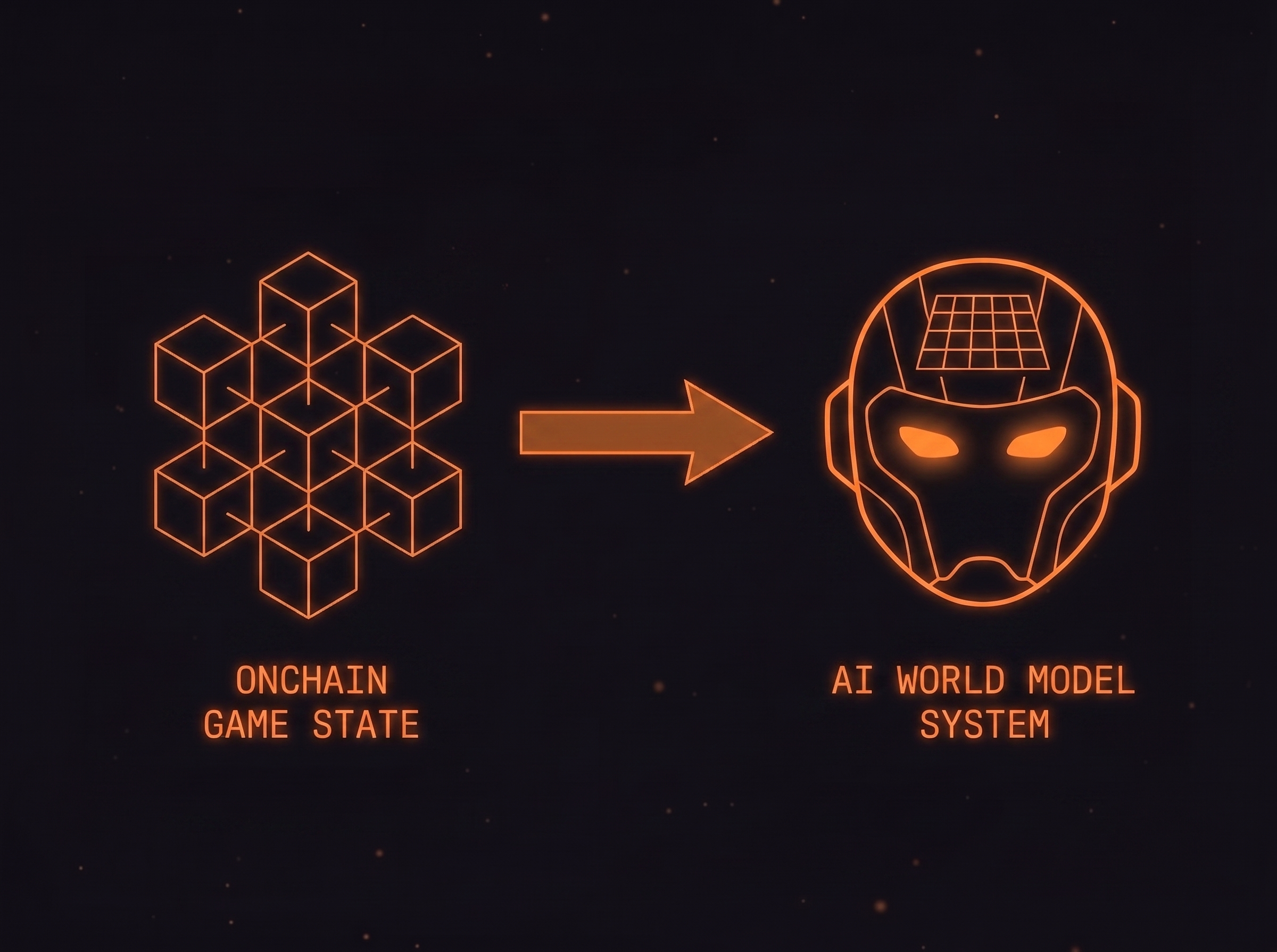
Onchain games provide the transparent, verifiable data that world models need to truly understand game logic.
What This Means for Players
Okay, enough theory. What does world model gaming actually mean for your experience as a player?
NPCs That Actually Think
Imagine stealth game guards that don't follow predictable patrol routes because they're not following anything—they're actually patrolling. Making decisions about where to look based on their understanding of the space. Noticing that something seems off even if they can't see you directly.
World model NPCs wouldn't just react to stimuli; they'd reason about the world. They'd have hunches. They'd get suspicious. They'd act in ways that feel genuinely intelligent rather than mechanically scripted.
AI Teammates You'd Actually Want
Anyone who's played co-op games with AI partners knows the frustration. They stand in doorways. They don't understand flanking. They use the wrong weapons at the wrong times.
World model teammates would understand the game the way you do. They'd predict enemy movements. They'd coordinate strategies. They'd adapt to your playstyle instead of following rigid scripts. For the first time, playing with AI might actually feel like playing with someone intelligent.
New Game Modes and Experiences
World models open up design possibilities that don't exist today. Games where the AI is genuinely creative. Procedurally generated content that makes sense because the AI understands what "making sense" means. Adaptive difficulty that actually adapts rather than just tweaking numbers.
Imagine a dungeon master AI that truly understands your RPG campaign—not just following dialogue trees, but comprehending the world, the characters, and the story. Making decisions that feel intentional and coherent. That's the promise of world model gaming.
Personalized Challenge
World models could let games actually learn you. Not just tracking your stats, but building a model of how you play. Your tendencies. Your weaknesses. Your preferred strategies.
Then the game adapts. Not by rubber-banding difficulty, but by creating opponents who understand your patterns and challenge you in meaningful ways. That's the difference between artificial difficulty and genuine challenge.
The Road Ahead
World models in gaming aren't fully here yet, but they're coming faster than most people expect. The research is advancing rapidly. The computing power is there. The techniques keep improving.
The games industry is about to undergo its most significant AI transformation ever. Not the buzzword AI we've been hearing about for years, but genuine machine understanding of interactive worlds.
For players, this means better games. Period. Smarter opponents. More helpful allies. Richer worlds. More emergent gameplay. The death of "the AI is cheating" because the AI will just... actually be good.
And for platforms building the open infrastructure that makes this possible—like the ecosystem Cartridge is developing—this represents an opportunity to be at the center of the next major evolution in how games work.
The NPCs are about to wake up. And games are about to get a lot more interesting.
Cartridge is building the infrastructure for onchain games. Learn more about how we're enabling the future of gaming at cartridge.gg.